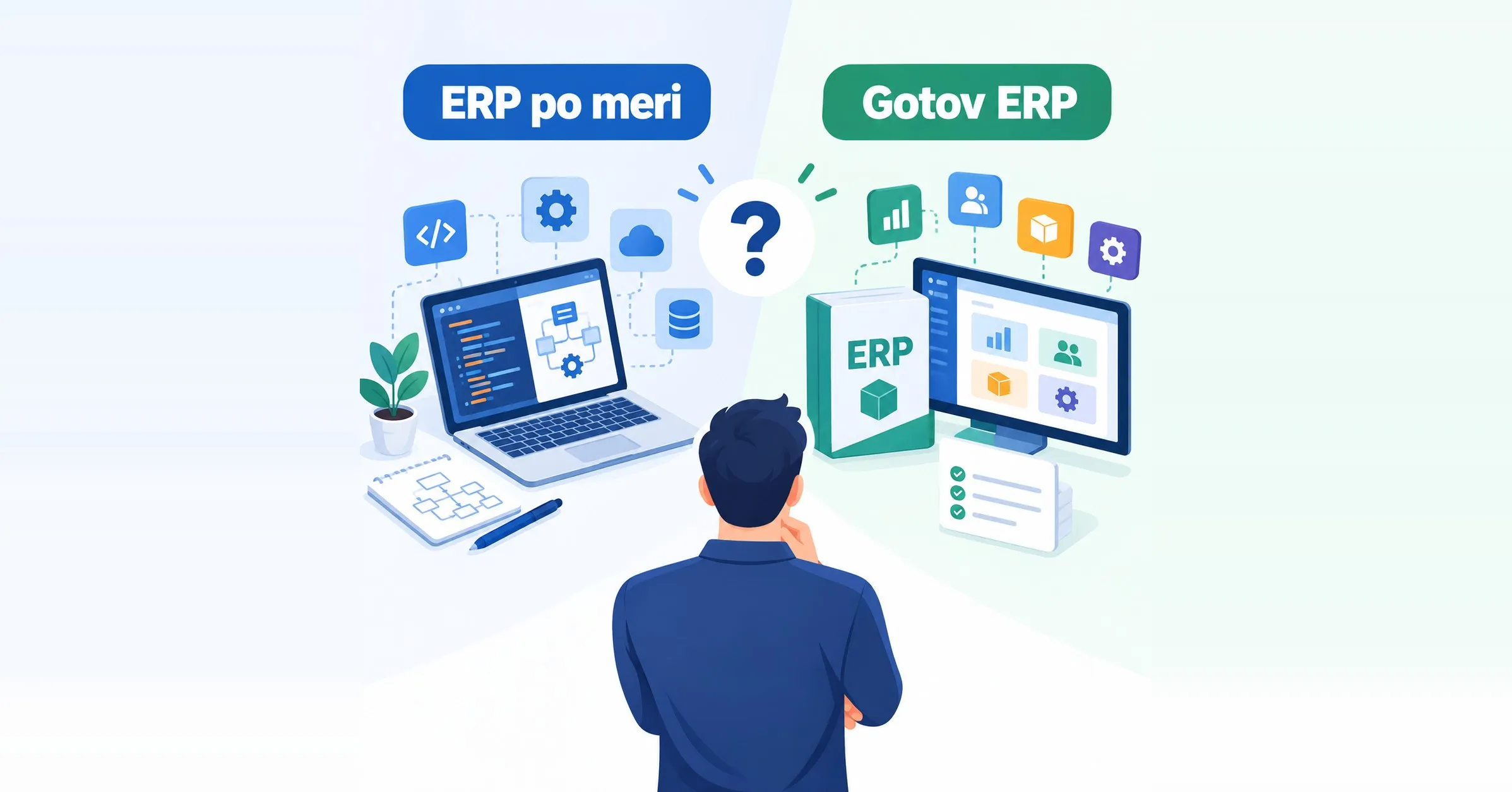
An off-the-shelf ERP is the better choice when your processes are standard — sales, purchasing, warehouse, accounting — and you want to start quickly with a known monthly cost. A custom ERP pays off when a program does not follow the way you work: production to customer drawings, your own process routings, many connected systems, or a team that works around the current program.
Tech Union, a software company in Belgrade, Serbia, builds custom ERP systems for manufacturing and trading companies. That is exactly why this article does not claim that custom is always better: we compare the public price lists of two off-the-shelf programs used in Serbia, our own timelines and terms, and an example from a project. The prices of the off-the-shelf programs were taken from the vendors’ websites on 29 October 2026 (both in Serbian). Before you decide, check whether they have changed.
How does an off-the-shelf ERP differ from a custom one?
An off-the-shelf ERP is a program that a vendor develops for many companies at once. You get ready-made modules and pay for the right to use them, usually per user. Your processes adapt to the program, and whatever the program does not cover is handled through configuration, add-ons or spreadsheets next to it.
A custom ERP is built for one company. The modules follow your processes, and the system and its code belong to you. The rollout takes longer than installing an off-the-shelf program, because the system has to be developed first.
There is also a third way: keep your accounting software and build only what it does not cover, such as production or the warehouse. More on this under “Can you have both?”.
How much do off-the-shelf ERP and accounting programs cost in Serbia?
Off-the-shelf programs are paid per user, by buying a licence or by monthly rent. As examples, we took two programs with public price lists.
PANTHEON (licence price list on datalab.rs). Prices are in euros excluding VAT, valid from 1 July 2025, and apply to one concurrent user (except LT3, a network licence for one to three users).
| How you pay | Range per user | Also worth knowing |
|---|---|---|
| Licence purchase | €119 to €1,649 | An update contract is mandatory with the first purchase: 22% of licence value a year |
| Rent in hosting | €14.90 to €68.90 a month | Data storage is included; extra storage is charged per GB |
| Connector licence | €159 (rent €8.90 a month) | Needed to connect PANTHEON with external systems |
The cheapest licence, LX, can be bought only once per company, for one user. Example: for five users with the SE licence at €1,099, the purchase comes to €5,495, plus €1,208.90 for the update contract every year. Rented, the same licence costs €45.90 a month per user, or €229.50 a month for five users.
Minimax (price list on minimax.rs). Minimax presents itself as business and accounting software. Prices are monthly rent in euros excluding VAT:
| Package | Monthly | What it adds |
|---|---|---|
| Izdati računi (issued invoices) | €10 | Pro forma invoices, invoices, e-invoices, fiscalisation, KPO |
| Mikro poslovanje | €16 | Received invoices, payment orders and bank statements, travel |
| Mini poslovanje | €21 | Cash desk, fixed assets, work orders, purchase orders |
| Maksi poslovanje | €28 | e-delivery notes (eOtpremnice), payroll, goods and materials |
Each additional concurrent user is €5 a month, and there are limits per organisation, such as 500 issued invoices a month. For five users, the Maksi package comes to €48 a month excluding VAT.
The licence does not include the rollout work: configuration, data migration and training. Both vendors have a separate price list for services and support.
How much does a custom ERP cost and how long does it take?
We set the price of a custom ERP after an analysis, because it depends on the number of modules and on the systems the ERP has to connect with. That is why we do not publish a fixed “from” price. What you know in advance:
- Timeline: an average project usually takes two to three months, and the smallest two to three weeks.
- Payment: a 30% advance at the start. With a Serbian company, the contract is in dinars with VAT; with a foreign company, in euros without VAT.
- Licences: there are no per-user licences. A new employee in the system does not raise the monthly cost.
- Warranty: we fix bugs during a warranty period of 1 to 24 months, depending on the project.
- After the warranty: a monthly support plan, from RSD 2,500 a month, depending on the project. It covers fixes, updates and new modules as the company grows.
- Ownership: after handover you get the code, the data and the documentation.
Comparison table: spreadsheets, off-the-shelf ERP and custom ERP
| Spreadsheets (Excel) | Off-the-shelf ERP | Custom ERP | |
|---|---|---|---|
| Getting started | Right away | After configuration and training | After analysis and development |
| Your processes | You adapt to the spreadsheets | You adapt to the program | The system follows your processes |
| Production to customer drawings | By hand | Depends on the program and add-ons | Modules built on your routings |
| Payment | — | Per user: licence or rent | A project, then monthly support |
| A new user | Free | A new licence or higher rent | No licence |
| Changes | Everyone edits their own file | Through the vendor or a partner | We add them as the company grows |
| Connections | Manual import and export | API or connector, if the program has one | An API built for your needs |
| Source code | — | Belongs to the vendor | Belongs to you |
When is an off-the-shelf ERP the better choice?
An off-the-shelf program is a sensible choice when:
- your processes are standard. You buy and sell goods, run a warehouse and keep the books, and the program already covers this without major changes;
- you need to start quickly. An off-the-shelf program is configured, not developed. Minimax, for example, offers a free 30-day trial;
- you have few users. For three to five users, the monthly rent of an off-the-shelf program is a predictable cost;
- accounting is your main need. Invoices, e-invoices and fiscalisation are already in the packages of off-the-shelf programs.
If this sounds like you, you probably do not need a custom ERP. You may only need an integration of an off-the-shelf program with your online store or a courier service.
When does a custom ERP pay off?
A custom ERP pays off when an off-the-shelf program makes you change the way you work, or when your team works around it:
- your production is unlike anyone else’s: you work to customer drawings with your own process routings, and you need to know how much material and tooling went into a job and where scrap occurs;
- your data is in five places: the warehouse, sales and accounting live in separate programs and spreadsheets, and month-end reports are put together by hand;
- you have many systems: your online store, marketplaces, eFakture, courier services and accounting need to exchange data on their own;
- you have many users: every new user of an off-the-shelf program means a new licence, while in a custom ERP a new user needs no licence;
- changes never stop: every change to an off-the-shelf program goes through the vendor or a partner, so you wait and you pay.
Example: an ERP for a metal parts manufacturer
The client, from the metalworking industry, makes parts to customer drawings. The task was to track every product from order to shipment through all stages of production. We built an ERP with four modules:
- Receiving and movement of goods and materials: what has arrived, where it is and where it was moved.
- Production control: how many good parts and how much scrap, by stage and by shop.
- Process routings: the sequence of operations for each product, with the material and tooling it needs.
- Shipping: shipping orders for finished products based on stock and the state of production.
The result: less scrap, lower material and tooling costs, and management can see the performance of every department and shop. We do not disclose the client’s name.
A task like this is typical for a custom ERP: every part has its own sequence of operations, material and tooling, and that is exactly what needs to be tracked. We have also built sales, purchasing and finance modules.
Can you have both?
Yes. Accounting stays in the program you already use, and only what that program does not cover is built to order: production, the warehouse or shipping. A custom ERP exchanges data with your accounting software and eFakture (SEF), the Serbian e-invoicing system, through intermediary services and their APIs, or by exchanging files.
Before you decide, check whether your program allows connections and what they cost. For example, Minimax states that API access is available only to active subscribers, and PANTHEON requires connector licences to connect with external systems.
How to decide: five questions
- Which processes does an off-the-shelf program not cover, and how do you handle them today?
- How many people need to work in the system now, and how many in three years?
- Which systems must the ERP exchange data with?
- What will licences or rent cost over three to five years, including rollout and support?
- What happens if the vendor changes its prices or terms, or if you want to change partners?
If your answer to the first question is “nothing important”, start with an off-the-shelf program. If the answer is a long list, let’s talk about a custom ERP: after the analysis you get a plan of modules, a timeline and a price — or the advice that an off-the-shelf program suits you better.